Writing a Lean Business Plan – Template Download
Creating a lean business plan has become the go-to approach for entrepreneurs and business owners who need strategic clarity without the burden of writing lengthy, traditional business documents. Whether you’re launching a startup, pivoting an existing venture, or testing a new product line, this streamlined planning method enables you to map your strategy, identify key metrics, and start executing within hours rather than weeks.
The beauty of lean business planning lies in its practicality and flexibility. Whilst traditional business plans often collect dust on shelves, a lean business plan serves as a living document that guides your daily decisions and adapts to market changes through regular monthly or quarterly reviews. By the end of this guide, you’ll understand exactly how to create your own lean business plan, with templates and examples to accelerate your progress.
Definition of Lean Business Plan?
A lean business plan is a concise, 1-5 page actionable document capturing essential business strategy elements. Unlike exhaustive reports for external investors, it focuses on internal management and rapid execution. The U.S. Small Business Administration records that, lean plans can be created in as little as one hour, making them ideal for entrepreneurs seeking quick business starts or explanations.
The key difference from traditional planning lies in purpose and frequency. Traditional plans serve as 20-30 page investor documents with detailed financials and extensive market research, while lean plans function as living strategic tools for daily decision-making, updated regularly as circumstances change. Tim Berry, founder of Palo Alto Software and creator of lean business planning methodology, emphasizes that “the point of the business plan, for real business in the real world, is not the plan itself but the planning process” focusing on small steps, consistent tracking, and frequent course corrections.
Here’s a quick comparison to clarify the differences:
| Feature | Traditional Business Plan | Lean Business Plan |
|---|---|---|
| Length | 20-30+ pages | 1-5 pages |
| Primary Purpose | Convince lenders/investors | Guide daily decisions and rapid testing |
| Detail Level | Extensive financial projections and research | Essential metrics, milestones, and assumptions only |
| Update Frequency | Infrequent (yearly or major events) | Frequent and iterative (monthly/quarterly) |
| Format | Formal document with extensive prose | Bullet points, lists, and tables |
Lean business plans are particularly valuable for startups validating ideas, small businesses adjusting to market changes, solo entrepreneurs testing concepts, and even established firms piloting new products or services. The methodology prioritizes learning and adaptation over exhaustive documentation.
Read also: Easy ways to Finding Your Business Niche
Lean Business Plan Template (LBT)
A lean business plan template is a structured 1-2 page outline that helps you quickly map your strategy, customers, revenue model, and key actions without writing a full traditional plan. Essentially, it provides a framework with guiding questions and sections that prompt you to think through your business’s critical components whilst maintaining brevity and clarity.
However, it’s crucial to distinguish between different planning tools to avoid confusion. Many entrepreneurs conflate lean business plan templates with Lean Canvas or Business Model Canvas. Whilst these tools share similarities, they serve different purposes:
Lean Business Plan Template:
- Document-based planning tool with narrative sections
- Focuses on strategy, tactics, metrics, and financials
- Created by Tim Berry for ongoing business management
- Best for internal planning and regular reviews
Lean Canvas:
- Single-page visual framework with nine blocks
- Created by Ash Maurya for startups under extreme uncertainty
- Emphasizes problems, solutions, and key metrics
- Ideal for validating business ideas before heavy investment
Business Model Canvas:
- Comprehensive one-page business model visualization
- Created by Alexander Osterwalder for established businesses
- Focuses on value creation, delivery, and capture
- Better suited for operational planning and stakeholder communication
Effective lean business plan templates come in multiple formats to suit different preferences. A table-based version works well for systematic thinkers, featuring sections in the left column with guiding questions on the right. Alternatively, a bullet-point outline suits those who prefer to copy headings directly into their preferred document editor. The SBA provides free downloadable templates in both traditional and lean formats.
Benefits of a Lean Business Plan
Numerous benefits are offered by a lean business plan, making it an attractive choice for entrepreneurs. Firstly,
saves time: you can draft one in hours rather than weeks, enabling faster launches like a new café opening within weeks instead of months. Additionally,
Flexibility: Its Flexibility allows easy updates as markets evolve, ensuring your strategy remains relevant.
Enhanced focus: Where priorities are narrowed to three to five key initiatives, avoiding scattered efforts. For example, an e-commerce shop might concentrate on customer acquisition metrics, leading to better resource allocation. However, team alignment is improved through monthly reviews, fostering collaboration and quick adaptations based on data.
Tailored benefits apply to various types: startups gain from rapid validation, while SMEs benefit from agile pivoting. Consultants and agencies, in particular, appreciate the clarity in scaling operations.
Overall, this approach, aligned with one-page business plan simplicity, boosts efficiency across scales.
When Should You Write Your Lean Business Plan?
Your lean business plan should be written at key moments to maximise its impact. Start before building your minimum viable product (MVP) or committing significant capital, as it clarifies assumptions early. Furthermore, create one when pivoting, such as adding an e-commerce channel to a physical store.
Quarterly strategy reviews also trigger updates, realigning goals with current metrics. Before engaging investors or partners, draft a version for concise overviews. For instance, a freelancer expanding to an agency might write it to define niches and hiring needs prior to growth.
In essence, treat it as an iterative tool: review monthly if metrics shift, or after customer feedback reveals gaps. This timing ensures the plan supports proactive decisions.
Read also: 7 Top Trending Digital Skills with Free Certifications
Parts and What to Include in a Lean Business Plan
- Set a clear objective and time limit: Aim for a two-page draft in 90 minutes to keep momentum high.
- Define your value proposition: Use this prompt: “We help [target customer] who struggle with [problem] by offering [solution] so they can [benefit].”
- Identify target customers: Research segments and note their needs, pains, and behaviours.
- Outline products/services: List offerings, pricing, and differentiation.
- Map marketing and sales: Specify channels, tactics, and acquisition goals.
- Detail operations: Cover resources, processes, and partners.
- Build revenue and costs: Project streams and structures simply.
- Set metrics and milestones: Choose three to five KPIs, like leads per month, and three-month targets.
- Note assumptions and risks: List what could go wrong and mitigation steps.
- Establish an iteration loop: Schedule monthly reviews, incorporating feedback from sales data or customers.
This workflow, inspired by lean canvas adaptations, ensures actionability. For deeper steps, see LivePlan’s one-page guide.
Lean Business Plan Example
Seeing a complete lean business plan in action clarifies how all components fit together. Below is a realistic example for a B2B service business, followed by brief variants for other industries.
Complete Example: CloudClarity Consulting
Business Overview: CloudClarity Consulting helps mid-sized manufacturing companies (50-250 employees) migrate legacy systems to cloud platforms, reducing IT costs and improving operational efficiency.
Value Proposition: Whilst general IT consultancies treat cloud migration as a technical project, we provide industry-specific guidance that addresses manufacturing’s unique requirements (equipment integration, production uptime, compliance). Our clients complete migrations 40% faster with minimal disruption.
Target Customers:
- Manufacturing operations managers at companies with £5M-£25M annual revenue
- Currently using on-premise systems built 10+ years ago
- Frustrated by high IT maintenance costs and limited scalability
- Risk-averse regarding production downtime
Products/Services & Pricing:
- Assessment package: £5,000 (2-week audit and migration roadmap)
- Full migration service: £35,000-£75,000 (based on complexity)
- Post-migration support: £2,500/month retainer
Marketing & Sales Plan:
- Primary channel: LinkedIn thought leadership + targeted connection requests
- Content strategy: Weekly posts about manufacturing cloud challenges, monthly webinars
- Sales process: Initial consultation (free), paid assessment, proposal for full project
- Partnership network: Manufacturing trade associations, equipment vendors
Operations & Key Resources:
- Founder (senior cloud architect, 15 years experience)
- Two contract cloud engineers (engaged per project)
- Partnership with cloud provider for technical support
- Project management software and CRM
Revenue Model & Costs:
- Year 1 target: 6 full projects + 3 retainer clients = £240,000 revenue
- Major costs: Contract engineers (project-based), marketing (£1,500/month), tools (£800/month), business development (£500/month)
Key Metrics:
- Qualified sales conversations per month (target: 8)
- Proposal-to-close rate (target: 30%)
- Average project value (target: £50,000)
- Client satisfaction score (target: 9/10)
6-Month Milestones:
- Month 1-2: Complete first paid assessment, establish content calendar
- Month 3-4: Close first full migration project, hire first contract engineer
- Month 5-6: Achieve £50K revenue, expand LinkedIn following to 2,000
Key Assumptions & Risks:
- Assumption: Mid-sized manufacturers are actively seeking cloud migration help
- Risk: Sales cycle may extend beyond 60 days
- Test: Run targeted ad campaign to gauge interest and lead quality
Why this works: This example focuses on one specific customer segment and problem, maintains strategic alignment between all elements (premium pricing matches consultative approach), and sets clear metrics for measuring progress.
Lean Business Plan Template
Here’s a comprehensive template you can copy and customize for your business. Each section includes brief instructions to guide your thinking.
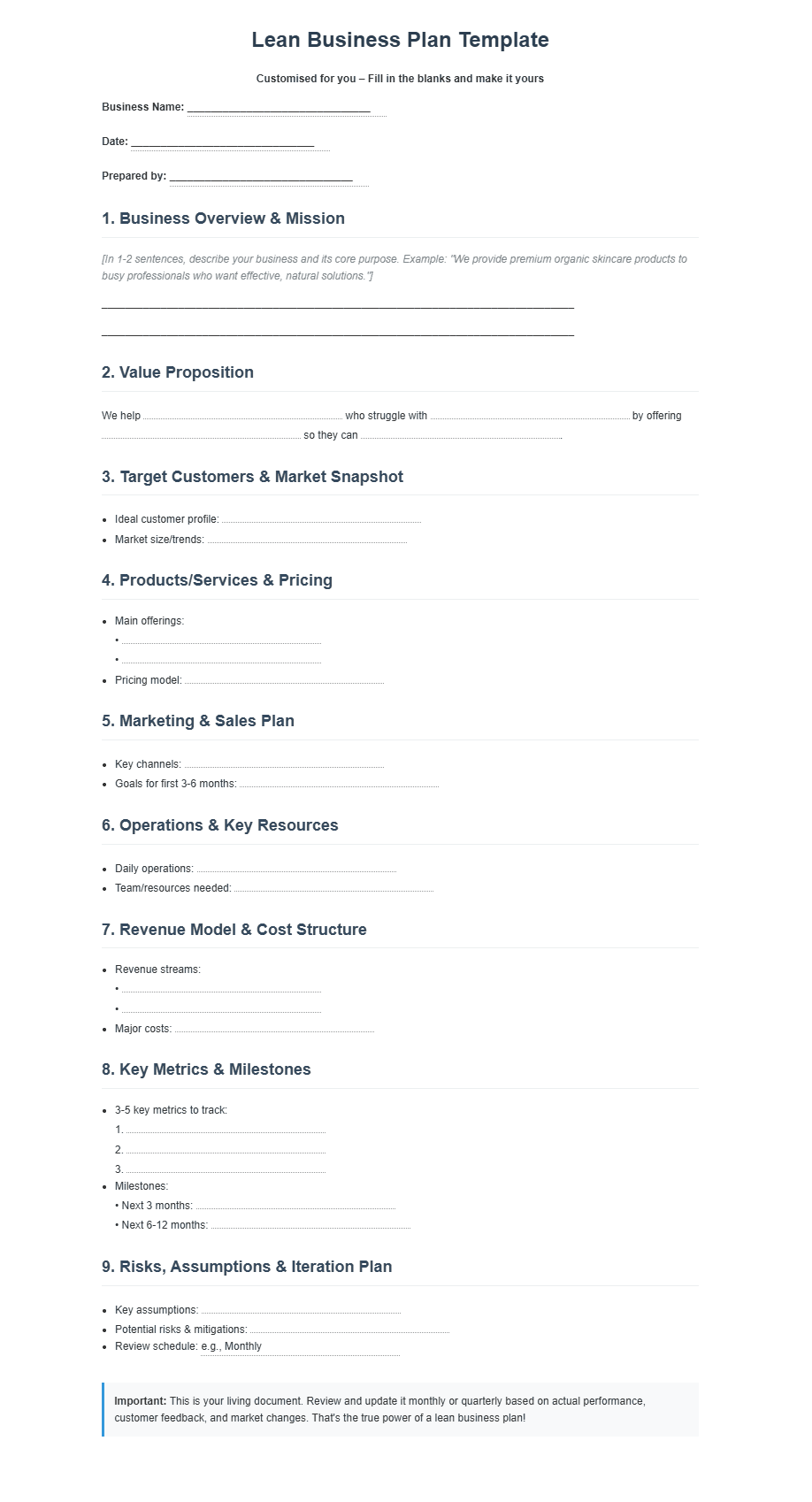
Customization Guidance by Business Type
For Solo Founders/Freelancers: Focus sections 6 and 7 on your personal capacity limits (hours available, maximum clients simultaneously) and hourly or project-based revenue calculations. Emphasise how you’ll transition from doing everything yourself to delegating specific tasks.
For Service Businesses: In section 6, detail your service delivery process, including typical project timelines and quality control measures. For section 8, track utilisation rates (billable hours vs. available hours) and pipeline metrics (qualified leads, proposals outstanding).
For Product Businesses: Expand section 6 to cover supply chain, inventory management, and fulfilment logistics. In section 7, include cost of goods sold and gross margin calculations. Track inventory turnover and reorder points in section 8.
For B2B/Enterprise: Extend section 5’s sales process to reflect longer sales cycles and multiple decision-makers. Add metrics around sales pipeline stages and average contract value in section 8.
Conclusion
Creating a lean business plan transforms abstract ideas into actionable strategies that guide daily decisions and drive measurable progress. By focusing on essential elements, value proposition, target customers, key metrics, and tactical next steps, you gain strategic clarity without weeks of exhaustive documentation that quickly becomes outdated. The true power lies not in producing a perfect document, but in establishing a regular rhythm of planning, executing, measuring, and adjusting. Your initial 90-minute session launches this cycle, but monthly or quarterly reviews based on real results create sustained competitive advantage.
Keep in mind that Your lean business plan is a living tool, not a static artefact. Markets shift, customer preferences evolve, and unexpected opportunities emerge. By maintaining a lightweight, flexible planning process, you position your business to respond quickly and capitalize on changes that leave rigid competitors struggling. Whether launching a startup, growing an established business, or piloting a new initiative, lean business planning provides necessary structure and focus whilst preserving the agility required in today’s dynamic markets.
Frequently Asked Questions
What’s the difference between a lean business plan and a traditional business plan? A lean business plan is 1-5 pages focused on strategy, tactics, and metrics for internal management, updated monthly or quarterly. Traditional business plans are 20-30+ pages with extensive detail, primarily created for external investors or lenders, and updated infrequently.
How long should a lean business plan be? Most lean business plans range from 1-5 pages, with many entrepreneurs finding that 2-3 pages provides sufficient detail without excess. The ideal length depends on your business complexity, but if you’re exceeding 5 pages, you’re likely including unnecessary detail better suited for supporting documents.
Can I use a lean business plan to apply for funding? Whilst lean business plans work excellently for internal management, most traditional lenders and investors expect more comprehensive documentation. However, your lean plan provides a solid foundation that you can expand with additional financial projections, market research, and formal formatting when seeking external funding.
How often should I update my lean business plan? Best practices from lean planning experts recommend monthly reviews for startups and rapidly growing businesses, whilst established companies typically benefit from quarterly reviews. The key is maintaining a regular cadence that keeps your plan aligned with current realities.
Do I need special software to create a lean business plan? No special software is required. Many entrepreneurs successfully use Google Docs, Microsoft Word, or even simple text editors. However, dedicated business planning tools like LivePlan or similar platforms can streamline the process, particularly for financial forecasting and collaborative review sessions. Choose whatever tools match your preferences and workflow.